
LaTerra Development is attempting to lower Burbank’s job-to-housing ratio several hundred multifamily units at a time.
As it stands, for every 3.9 jobs in the city of Burbank, there is only one unit of housing, according to Burbank’s Economic Development Division.
“Burbank is in a severe housing crisis,” said Chris Tourtellotte, managing director at LaTerra, which is based in Marina del Rey. “There’s a significant amount of jobs and not a lot of housing units. We at LaTerra are trying to solve that.”
This commenced with the firm’s Intro Burbank development, a multiphase mixed-use project. The residential components of Intro, which finished construction over the summer, added 573 units to Burbank’s housing stock.
To date, Intro is LaTerra’s “biggest project by far,” Tourtellotte said. “It’s a really unique and remarkable project.”
Mary Hamzoian, economic development manager at the city of Burbank, touted the largescale impact of such sizable projects, noting Intro’s ability to “make a noticeable impact on the city’s housing supply (compared to) smaller infill projects.
“Additionally, large mixed-use projects help to simulate commercial growth for the area, attracting a built-in population that attributes to additional retail, services and amenities that support a 24/7 neighborhood and strengthen downtown Burbank’s long-term vibrancy,” Hamzoian said.
Along with the units created at Intro, LaTerra is behind the redevelopment of Fry’s Electronics in Burbank, which is entitled for 862 apartments.
When Burbank has 42,727 housing units compared to 166,714 jobs, according to the city’s Economic Development Division, Tourtellotte acknowledges that “it’s not a massive dent, but it’s a step in the right direction.”
Industry tailored
At the forefront of Intro’s design was appealing to Burbank’s large pool of entertainment industry professionals. This led to Intro’s two residential buildings being named The Writer and The Actor and being amenitized as such.
Including writing lounges, a hair and makeup room, a green screen room with props, a podcast room, a movie theater and concession stand was a part of this strategy. LaTerra consulted with the real estate teams from “a couple of the big Burbank media companies,” Tourtellotte said, to serve as advisers on the design of the buildings’ media-targeted features.
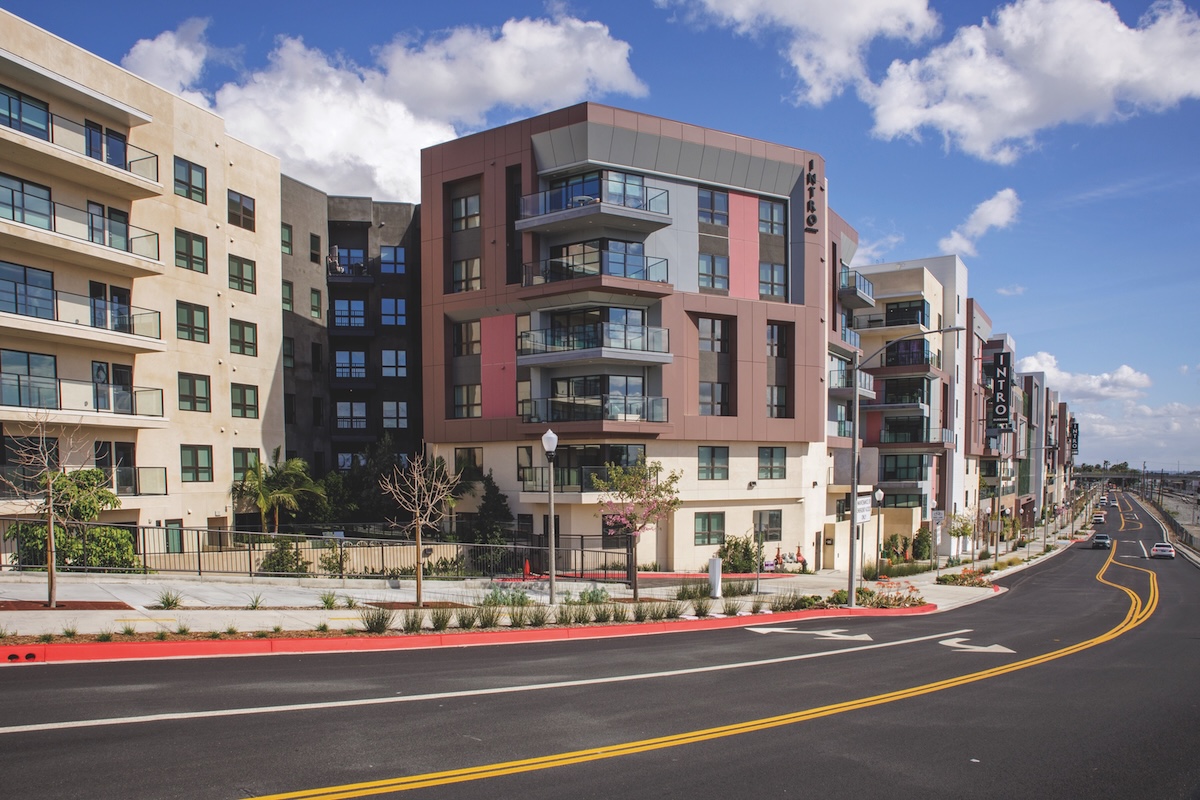
“When we designed the project, we really leaned into Burbank being the media capital of the world,” he said.
Curating projects to specific resident and demographic bases has evolved into a trend that Tourtellotte expects to continue, especially in the age of remote and hybrid work schedules. This also creates opportunities for community building as professionals and creatives with similar interests share in these workspaces.
Hamzoian too sees the benefits of amenities “that cater to Burbank’s highly concentrated creative industry workforce.”
“Positioning the property as a distinctive live-work space also adds real value, with amenities that support a flexible lifestyle and even shorten commutes,” she said.
Partial pivot
While Tourtellotte said he could not disclose the overall budget for the project, he valued it at $500 million.
In addition to The Writer and The Actor, the site has also built out about 1,100 square feet of retail space. LaTerra has not yet signed on a tenant for that space.
Since the genesis of Intro, LaTerra earmarked its last piece of land for a 300-room hotel with the 2028 Olympics and Paralympic Games in mind.
Now that “the financing market for hotel development has slowed,” Tourtellotte said the firm is contemplating changing courses, though he was unable to share specifics at this time.
“We are considering alternate uses for the hotel land that we think would be a win-win for us and the city,” he said, adding that they expect to break ground on the allusive third phase in 2027.
Family appeal
As far as leasing efforts go for the residential portion of the project – which includes studios, one-, two- and three-bedroom units – Tourtellotte said the team has been pleased so far, noting that Intro’s three-bedroom units have been especially in demand.
In part, he thinks this is due to displacement coming from Altadena, but also because homeownership in Burbank can be quite pricey as families flock to the area for safety and a good school district.
Between 2020 and 2025, the average value of a single-family home in Burbank has increased by 40%, according to the city’s Economic Development Division. In January, Redfin reported that the median price for a home in Burbank was $1.5 million.
“There are many families that want to be in Burbank, but they can’t afford a home,” Tourtellotte said. “… It’s very expensive, and so that has caused us to lease the three bedrooms faster than we thought. That being said, we’re seeing demand across all unit types.”
Of Intro’s 573 units, 69 are designated as affordable housing. For the market rate units, rents range between approximately $2,600 to $5,500 depending on the unit type.
When it comes to continuing to chip to away at Burbank’s housing to job ratio, it’s important the city create building incentives, remove obstacles and reduce costs, Tourtellotte said.
Some of the city’s efforts include providing density bonuses and regulatory incentives for housing projects in mixed-use and transit areas, according to Hamzoian.
“To further address the jobs-to-housing imbalance, Burbank actively markets development sites, and the Planning Division is coordinating several Specific Plan updates including a Downtown Burbank Transit-Oriented Development Plan, the Media District Specific Plan and the Golden State Specific Plan which will prioritize housing near transit hubs and major commercial corridors,” Hamzoian said.